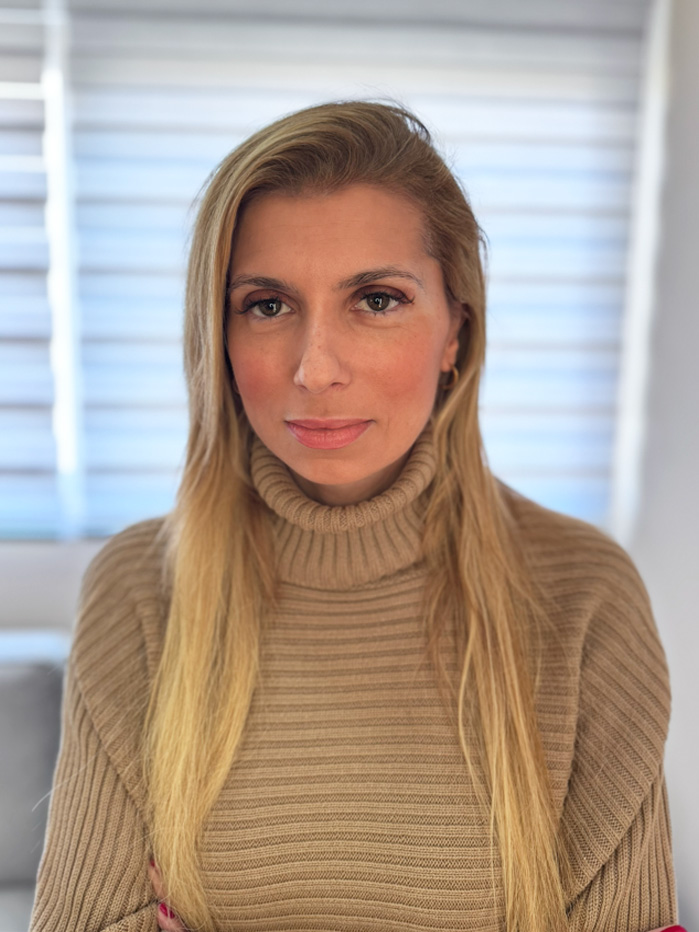
 Counseling Psychologist & RECBT Practitioner
Dr. Anna-Maria Plessa
Coordinator of Counseling Services at the Hellenic Institute for RECBT
I offer psychotherapy for individuals, couples, families and groups, in English or Greek. My work combines humanistic-existential principles with cognitive-behavioral and attachment-informed approaches.
Sessions in English and Greek
In person or online, on Zoom, Microsoft Teams or Google Meet.
Book an appointment My approachHow I work
Humanistic-existential principles combined with RECBT and attachment-informed practice.
Read more How I can helpAreas I work with
Anxiety and depression, relationships, trauma, bereavement, substance misuse and more.
Explore topicsAbout me
I'm a psychologist and psychotherapist. I started my training and clinical work more than ten years ago, in psychological neuroscience, clinical and counseling psychology, and therapy.
My doctoral work focused mainly on counseling psychology and mental health in substance misuse. In my research I used grounded theory to map out how change happens in therapy, from the point of view of people with a history of substance misuse who found therapy helpful in their recovery.
Over the years I've worked with children, adolescents, adults and older adults in the NHS (the UK's National Health Service), international cognitive rehabilitation day centers, private hospitals, community drug and alcohol services, school counseling services and outpatient therapy institutes. The people I saw were dealing with emotional, behavioral, learning or neurological difficulties, and with difficulties related to personality.
I'm also fully accredited as a Rational-Emotive and Cognitive-Behavior Therapist. Since 2013 I've been a fellow of the Hellenic Institute for Rational-Emotive & Cognitive-Behavior Therapy (RECBT) in Athens, a Preferred Partner of the Albert Ellis Institute in New York.
Education and credentials
Education
-
2020
Professional Doctorate (DPsych), Counselling Psychology
City, University of London, UK
-
2014
MSc, Counselling Psychology
City, University of London, UK
-
2011
MA, Clinical Psychology
La Salle University, Philadelphia, USA
-
2009
BSc, Psychology with Neuroscience
University of Westminster, UK
Licenses and memberships
- Licensed Psychologist, recognized by the Greek State License No. 688705
- Registered Practitioner Psychologist, Health and Care Professions Council (UK) HCPC Registration No. PYL039710
- Chartered Counselling Psychologist, British Psychological Society BPS / CPsychol No. 239867
- Associate Member, American Psychological Association APA Membership No. 29637509
- Accredited Test User, Occupational Ability & Personality Assessment, British Psychological Society RQTU Membership No. 239867
- Fellow, Hellenic Institute for RECBT (since 2013) Preferred Partner of the Albert Ellis Institute, New York, USA
Areas of specialization
How I can help
Select a topic to read more.
Anxiety, panic & worry
Constant worry, panic attacks, social anxiety or obsessive thoughts can wear you out. In therapy we look at what keeps the anxiety going and practise ways of responding to it.
Book an appointmentDepression & low mood
Low mood often comes with loss of interest and harsh self-criticism. We work on the thoughts and habits that keep you stuck, with the aim of accepting yourself.
Book an appointmentRelationships & intimacy
Problems with closeness, trust or conflict usually spill into the rest of life. Sessions are open to individuals, couples and families.
Book an appointmentTrauma & abuse
Trauma, abuse and domestic violence can affect a person for years. Therapy gives you a safe place to make sense of what happened, at a pace you can manage.
Book an appointmentLoss & life transitions
Bereavement can be deeply unsettling, and so can questions about meaning, choice and change. This work draws on existential approaches.
Book an appointmentEating & body image
Difficulties with food or with your body are often tied to how you feel about yourself. Therapy works on eating habits and on the beliefs behind them.
Book an appointmentSubstance misuse
Substance misuse was the subject of my doctoral research, and I worked for years in community drug and alcohol services. Together we can work on changing your use and on your recovery more broadly.
Book an appointmentAnger, shame & guilt
Anger, shame, guilt, jealousy and envy are normal emotions, but they can overwhelm you and strain your relationships. RECBT gives you practical tools to understand and manage them.
Book an appointmentPerfectionism & personal growth
Perfectionism, procrastination and pressure at work or in your studies often come from demanding beliefs about yourself. Therapy helps you make those beliefs more flexible.
Book an appointmentAll topics
Tap a topic to open its card above.
Who I work with
Sessions take place in person or online (Zoom, Microsoft Teams or Google Meet), in English or Greek.
Approach
I work in a warm, collaborative way. I combine evidence-based humanistic-existential principles with cognitive-behavioral approaches and attachment-informed theories of personality development and change, and I adapt them to you: to what you need and to where you are in therapy.
I keep learning through continuing professional development. In research, I'm interested in qualitative methods (grounded theory and hermeneutic phenomenology) and in how existential and attachment ideas help us understand mental distress. I'm also interested in post-traumatic growth, animal-assisted therapy and the way social media shapes how we relate to ourselves and to others.
How we start
-
1
Get in touch
Call, email or use the form below to arrange a first appointment.
-
2
First session
We get to know each other and talk about what brings you to therapy and what you would like to change.
-
3
Working together
We agree on a plan that fits your needs and check together how it is going.
Frequently asked questions
Do you offer online sessions?
Yes. Sessions take place in person as well as online via Zoom, Microsoft Teams or Google Meet, so you can join from wherever you are.
In which languages are sessions held?
Sessions are held in Greek or in English, whichever you prefer.
What happens in the first session?
The first session is a chance to get to know each other. We talk about what brings you to therapy and what you hope to change, and decide together how to continue.
Who do you work with?
Adults, adolescents, couples, families and groups.
Is what I share confidential?
Yes. Everything discussed in sessions is confidential, in line with professional codes of ethics. The only exceptions are the rare cases provided for by law, such as a serious risk to your safety or the safety of others.
Book an appointment
To book a session, call me, email me or send a message using the form below.
or send a message